With Section 21 eviction notices on their way out later this year through the Renters’ Rights Act, many private renters are currently still vulnerable to ‘no-fault’ eviction as landlords can take their final opportunity to use this power.
It’s important that renters understand our rights when it comes to Section 21 evictions. Many Section 21 notices are not valid, which means a landlord cannot use it to evict you, and you may be able to stay in your home.
What is Section 21?
A Section 21 notice is a notice that a landlord can serve to a private renter with an Assured Shorthold Tenancy (AST) to begin the legal process to end the tenancy – in other words, to evict you.
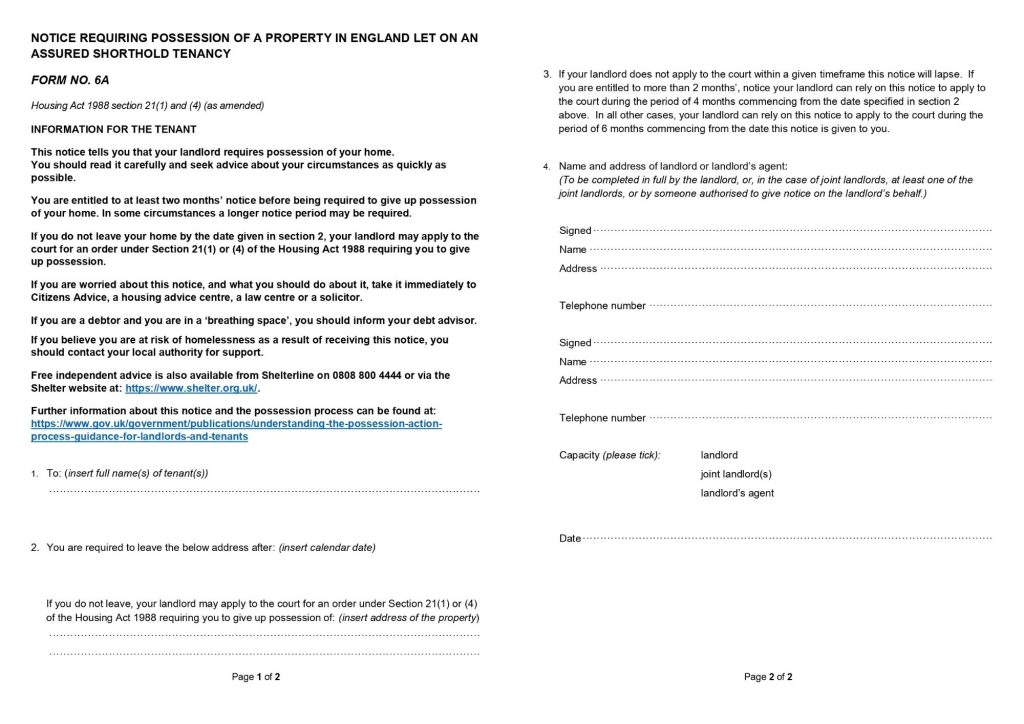
A valid Section 21 notice needs to be served using the correct form, called form 6A, in its current version. It looks like this:
Reasons your Section 21 notice might be invalid include:
- Because your landlord didn’t use the current form 6A
- Because your landlord provided incorrect information on the form, such as the wrong address or name
- Because the landlord isn’t giving you 2 months’ notice
- Because you’re in the first 4 months of a new tenancy, or in the middle of a fixed-term tenancy and don’t have a break clause
- Because your landlord didn’t protect your deposit, or protected it late (more than 30 days after you paid it)
- Because your landlord didn’t give you details called ‘prescribed information’ about your deposit and deposit protection scheme
- Because your landlord charged you more than 5 weeks’ deposit, or other banned fees, and has not paid these back
- Because your home needs a licence under Southwark Council’s licensing scheme, and your landlord doesn’t have the licence
- Because you started your tenancy after 1 October 2015 and your landlord did not give you the correct documents when you started the tenancy (EPC, gas safety certificate, correct How to Rent guide)
- Because you complained to the Council about repairs and they gave your landlord an improvement notice or emergency notice in the last 6 months (a ‘revenge eviction’)
What next?
If the Section 21 notice is not valid, your landlord cannot evict you through this method. They would need to reissue a valid Section 21 notice. Find out more about checking if your Section 21 notice is valid:
If the Section 21 notice is valid, your landlord still needs to go through the court for a possession order and get a warrant for eviction (i.e., getting bailiffs to evict you). This might take several months, during which you can stay in the property. If they try to force you to leave before getting a warrant, this is an illegal eviction. Find out more about what happens after a valid Section 21 notice, and your rights:
Deadlines for using Section 21
Since Section 21 evictions are being abolished later this year, there is a deadline for landlords to start court proceedings.
If you have received a valid Section 21 notice, or receive one before 1 May 2026, your landlord must start court proceedings to evict you within 6 months, or by 31 July 2026, whichever is sooner. If your landlord has not started court proceedings by 31 July 2026, the Section 21 notice will not be valid.
Section 21 is coming to an end! If you receive a Section 21 notice after 1 May 2026, it will not be valid.
We’ll be posting more information about renters’ rights and changes under the Renters’ Rights Act.
Subscribe to our newsletter to make sure you stay up-to-date with changes in law and support available for renters.